Start a Search:
Author: Action Alliance
HUD, DOJ, and HHS Release Joint Letter Providing Information Regarding Access to Federally Funded Life-Saving Services and Housing for Immigrants
(as originally posted at the HUD Exchange on August 11, 2016)
HUD, HHS, and DOJ Joint Letter Regarding Immigrant Access to Housing and Services
This letter issued jointly by the U.S. Department of Housing and Urban Development (HUD), the U.S. Department of Health and Human Services (HHS), and the U.S. Department of Justice (DOJ) reminds recipients of federal funds how the Personal Responsibility and Work Opportunity Reconciliation Act (PRWORA) of 1996 applies to their programs.
Housing and service providers must not turn away immigrants experiencing homelessness or victims of domestic violence or human trafficking, on the basis of their immigration status, from certain housing and services necessary for life or safety – such as street outreach, emergency shelter, and short-term housing assistance including transitional housing and rapid re-housing funded through the Emergency Solutions Grants (ESG) and Continuum of Care (CoC) Programs. This letter reiterates existing laws and policies and applies those policies to programs that were not in effect when the original Attorney General Order was signed in 2001.
If you have any questions, please submit them to the HUD Exchange Ask a Question (AAQ) Portal. If you have questions related to the CoC Program, please select “CoC Program” from the “My question is related to” drop down list on Step 2 of the question submission process. If you have questions related to the ESG Program, please select “ESG Program” from the “My question is related to” drop down list on Step 2 of the question submission process.
Click here to read the joint letter.
Human Trafficking Prevention Toolkit
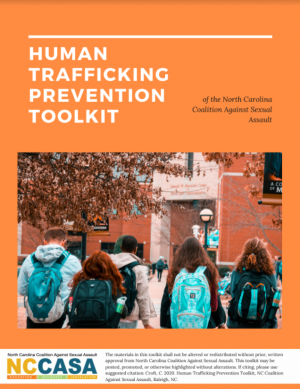
Human trafficking prevention has at times been framed primarily as a criminal justice priority or been siloed from other forms of violence prevention. As experts in sexual violence prevention, NCCASA recognizes sex trafficking as a form of sexual violence and the connection of sexual violence to all forms of human trafficking. NCCASA is pleased to present the Human Trafficking Prevention Toolkit. In this toolkit, you'll find the Human Trafficking Prevention Overview, an overview of what human trafficking is and the public health approach to violence prevention, an exploration of the historical context that informs current frameworks and gaps, tips for effective upstream prevention, and strategies for incorporating a harm reduction lens into your human trafficking prevention work, as well as critical considerations in selecting a prevention strategy.
I Ask - Sexual Assault Awareness Month
Sexual Assault Awareness Month (observed annually in April) is a campaign to raise public awareness about sexual violence and educate communities on how to prevent it. The campaign theme, I Ask, champions the message that asking for consent is a healthy, normal, and necessary part of everyday interactions. You can download and print materials for your Sexual Assault Awareness Month activities below!
- I Ask for Consent Palm Card and Handout cover the basics of knowing how to ask for and recognize consent. For best graphic quality, download the PDF and then print it out.
- I Ask for Digital Consent Palm Card and Handout discuss the importance of consent in online interactions. For best graphic quality, download the PDF and then print it out.
- I Ask How to Teach Consent Early Palm Card and Handout instructs parents on how to model consent with children in late childhood and early adolescence. For best graphic quality, download the PDF and then print it out.
- I Ask How Power Impacts Consent Palm Cards and Handout looks at the way imbalances of power impact consent. For best graphic quality, download the PDF and then print it out.
For additional resources, visit the National Sexual Violence Resource Center (NSVRC).
I-CAN! Understanding Protective Orders in Richmond, Virginia
The I-CAN! Understanding Protective Orders in Richmond, Virginia Booklet describes what a protective order is, the types of protective orders, the process of obtaining a protective order in Richmond, Virginia, tips about going to court, what to do after you receive a protective order, and various resources.
Attached is (1) the English version of the booklet, (2) a large print English version of the booklet, and (3) a Spanish version of the booklet.
Immigrants and Refugees Are Welcome Here: A Resource Guide for Service Providers Working with Immigrants who are LGBTQ, Sex Workers, and/or HIV-Positive
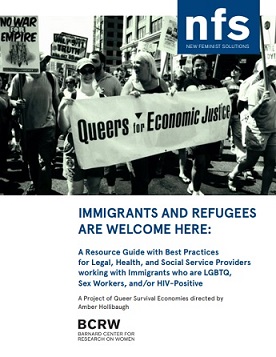
A Project of Queer Survival Economies directed by Amber Hollibaugh, produced with support from the Evelyn and Walter Haas, Jr. Fund
Description
Since the Trump administration took office in January 2017, violence against undocumented and documented immigrants, trans and gender nonconforming people, sex workers, Muslims, Black people and people of color, and other vulnerable groups has increased and taken many forms: economic, political, bodily, sexual, and social. People who occupy multiple marginalized social and structural positions experience these forms of oppression and violence with a sharper edge and more routinely in their everyday encounters. Though communities organize to resist this violence and build networks and systems for sanctuary and self-defense, people who are targeted by vigilante violence, racist policing, laws criminalizing poverty and survival-based economies, and the ramping up of local law enforcement and border enforcement have minimal access to legal recourse, systemic accountability, or reliable safety, reinforcing what are already precarious positions. Because of these conditions, immigrants who are documented and undocumented, LGBTQ, sex workers, and/or HIV-positive face particularly heightened vulnerabilities to violence, detention, family separation, deportation, and premature death.
This resource guide is intended for service providers to improve their competency in assisting clients in these dangerous times, and reduce secondary traumas in their practice. The guide contains a general overview of the landscape and vulnerabilities for immigrants who are LGBTQ, sex workers, and/or HIV-positive, suggestions for service providers in their daily practice, resources for organizational self-evaluation, and a glossary of terms. It is intended as a living document to be used and adapted based on feedback from clients, community members, activists, and service providers, as well as changes to our political landscape.
Table of Contents
- Credits
- Introduction: Understanding the landscape for immigrants who are LGBTQ, sex workers, and/or HIV-positive
- Specific Vulnerabilities
- Laws and Procedures
- Do’s & Don’ts for Service Providers
- Needs Assessments
- Glossary
- Terms Related to Gender and Sexuality
- Terms Related to Gender & Sexuality Oppression
- Terms Related to Immigration
- Terms Related to Sex Work
- Terms Related to HIV
- General Terms
- Resource List
- Organizations
- Reports
- Legal Resources
- Bibliography
Queer Survival Economies was established in 2014 by Amber Hollibaugh to work at the intersections of sexuality, poverty, homelessness, labor, and the criminalization of survival.
From 2014-2016 Amber L. Hollibaugh was a Senior Activist Fellow at the Barnard Center for Research on Women where she directed the Queer Survival Economies project. Hollibaugh is a writer, filmmaker and political activist whose work focuses on feminist, sex, and class politics. Her first book, My Dangerous Desires: A Queer Girl Dreaming Her Way Home (2000), presents over twenty years of Hollibaugh’s writing. Previously, Hollibaugh was the Chief Officer of Elder & LBTI Women’s Services at Howard Brown Health Center in Chicago, the Executive Director of New York’s Queers for Economic Justice (QEJ), Director of Education, Advocacy and Community Building at Services & Advocacy for GLBT Elders (SAGE). Among her health education work, she founded and directed the Lesbian AIDS Project at Gay Men’s Health Crisis in New York, for which she won the Dr. Susan M. Love Award for Achievement in Women’s Health.
The Barnard Center for Research on Women gratefully acknowledges support from the Evelyn and Walter Haas, Jr. Fund.
The Barnard Center for Research on Women engages communities through programming, projects, and publications that advance intersectional social justice feminist analyses and generate concrete steps toward social transformation.